Find the right waterjet cutting machine for sale with Fedjet. Compare specs across 4 machine series, UHP pumps & 5-axis heads. Get a quote today.
Waterjet Cutting Machine for Sale: The Engineering Guide to Choosing Industrial Equipment
The market for a waterjet cutting machine for sale presents a practical paradox: equipment is widely advertised, yet procurement teams consistently report difficulty distinguishing genuine production capability from marketing language. Specifications vary dramatically in their test conditions, reference standards, and measurable outcomes—and for teams without deep waterjet engineering experience, parsing these differences without context is challenging.
This guide provides the technical framework that experienced procurement engineers and plant managers use when evaluating CNC waterjet cutting machines. Rather than cataloging available options, it focuses on the criteria that separate production-grade equipment from entry-level imports—precision metrics, pump architecture, motion system design, and the total cost profile across a machine's operational lifetime.
- Pump pressure at or above 60,000 PSI (413 MPa) marks the threshold for production-grade metal cutting, per American Waterjet Association (AWA) technical guidelines
- Repeatability specifications matter more than absolute cutting precision for most production runs; ±0.03mm is achievable on mid-tier machines, ±0.01mm on precision-grade systems
- A waterjet cutting machine for sale that lists only purchase price obscures 70–80% of its total cost of ownership, which includes abrasive media, intensifier seals, water treatment, and energy consumption
- 5-axis capability adds significant cost but eliminates secondary machining for beveled edges, tapered profiles, and compound-angle cuts—payback analysis should account for labor savings and reduced part-handling time
The waterjet cutting equipment market serves a diverse buyer base: job shops ordering their first abrasive waterjet cutting machine, manufacturers specifying multi-axis systems for aerospace tier-1 supply chains, and fabrication shops modernizing away from plasma or laser. Each segment carries different expectations around machine scale, automation integration, and after-sales support. When you buy waterjet cutting machine equipment, understanding which tier of the market your application falls into directly shapes which specifications matter and which represent genuine capability versus marketing specification.
According to market analysis aggregated across MarketsandMarkets and Grand View Research, the global waterjet cutting machine market is valued in the $1.5–2.0 billion range with a projected compound annual growth rate exceeding 5% through 2030. Growth drivers include increasing adoption in aerospace component manufacturing, the rise of electric vehicle battery enclosure production requiring non-thermal cutting of composites, and continued demand in stone fabrication for countertop and architectural applications.
The geographic distribution of buyers has shifted meaningfully. North American and European shops represent mature markets where replacement cycles and precision upgrades drive purchases. Southeast Asia, the Middle East, and South America account for growing shares of new equipment procurement, with buyers increasingly evaluating Chinese-origin machines alongside established Western brands. This global buyer pool is the primary audience that a CNC waterjet cutting machine for sale listing reaches—and the context in which vetting a waterjet cutting machine manufacturer becomes a multi-month due diligence process rather than a commodity transaction.
For procurement decision-makers, this market structure creates both opportunity and risk. Competition drives pricing transparency for commodity configurations, but it also amplifies the challenge of identifying which manufacturers actually engineer and manufacture their own key subsystems—particularly pumps and cutting heads—versus those who integrate purchased components into resale packages.
Industrial waterjet cutting machines fall into four primary structural categories, each optimized for different production contexts. Understanding these distinctions is the first step in matching a machine to your operational requirements.
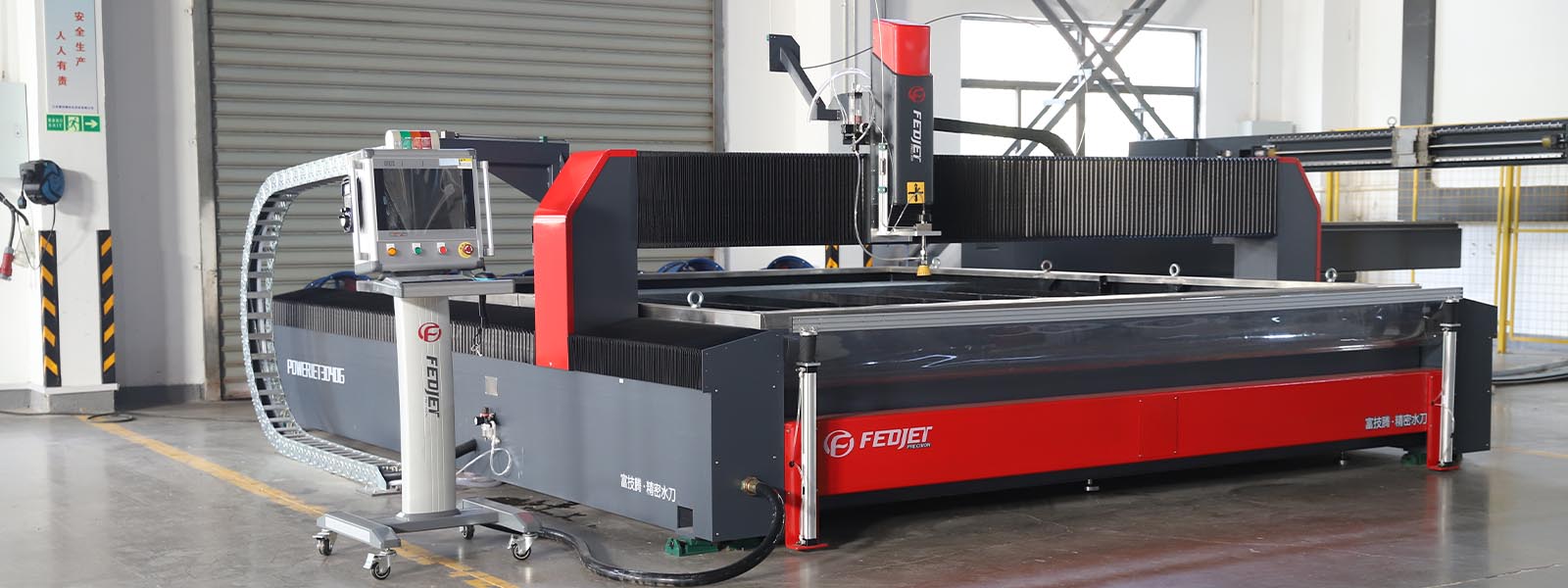
Gantry-style machines dominate the industrial waterjet market. The cutting head traverses along a stationary bridge structure while the material stays fixed on the worktable below. This design delivers superior rigidity for the weight class and accommodates the largest work envelopes—cutting tables exceeding 5 meters in the X-axis are almost exclusively gantry configurations.
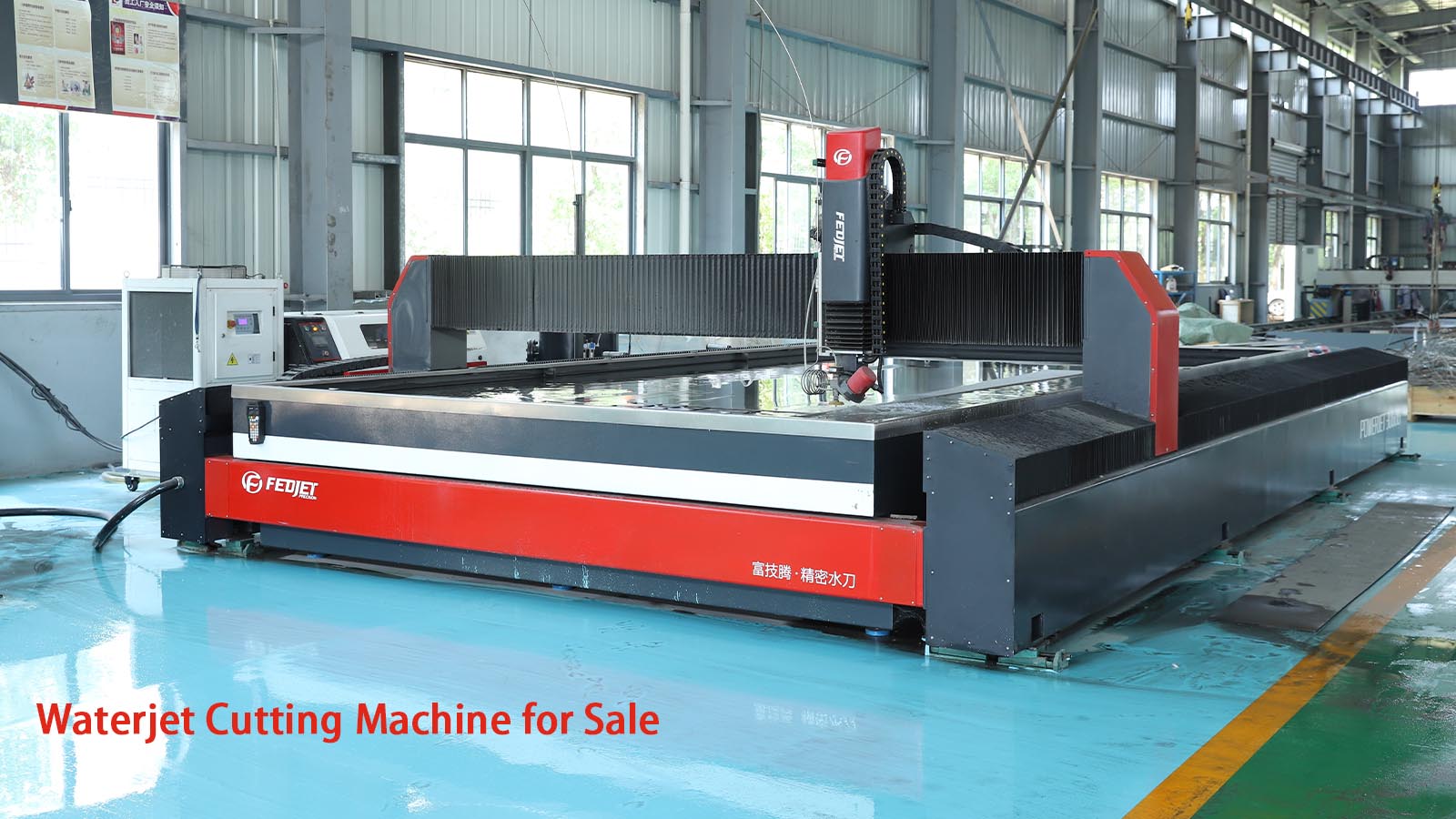
Fedjet's PowerJet G Series exemplifies this category. The machine uses a heavy-duty steel gantry frame with a corrosion-resistant structure and fully enclosed "Clean & Quiet" design that reduces airborne abrasive particulate. Standard configurations offer X-axis travels from 2.5m to 5.0m with Y-axis strokes from 1.5m to 20m, the latter being customizable for large-format stone or aerospace panel processing. Maximum rapid traverse reaches 20,000 mm/min, with fast jogging at 30,000 mm/min on certain models. Positioning accuracy is specified at ±0.038mm linear, with repeatability of ±0.03mm—adequate for most production metalworking and stone fabrication applications.
The PowerJet G handles materials up to 200mm thickness in metal and stone, powered by a 37KW/50HP pump delivering up to 60,000 PSI (413 MPa) . Both pure water and abrasive cutting modes are supported, enabling switching between soft material processing and aggressive metal removal without hardware changeover. Three-axis standard and optional five-axis configurations cover both basic 2D profiling and advanced bevel cutting needs.
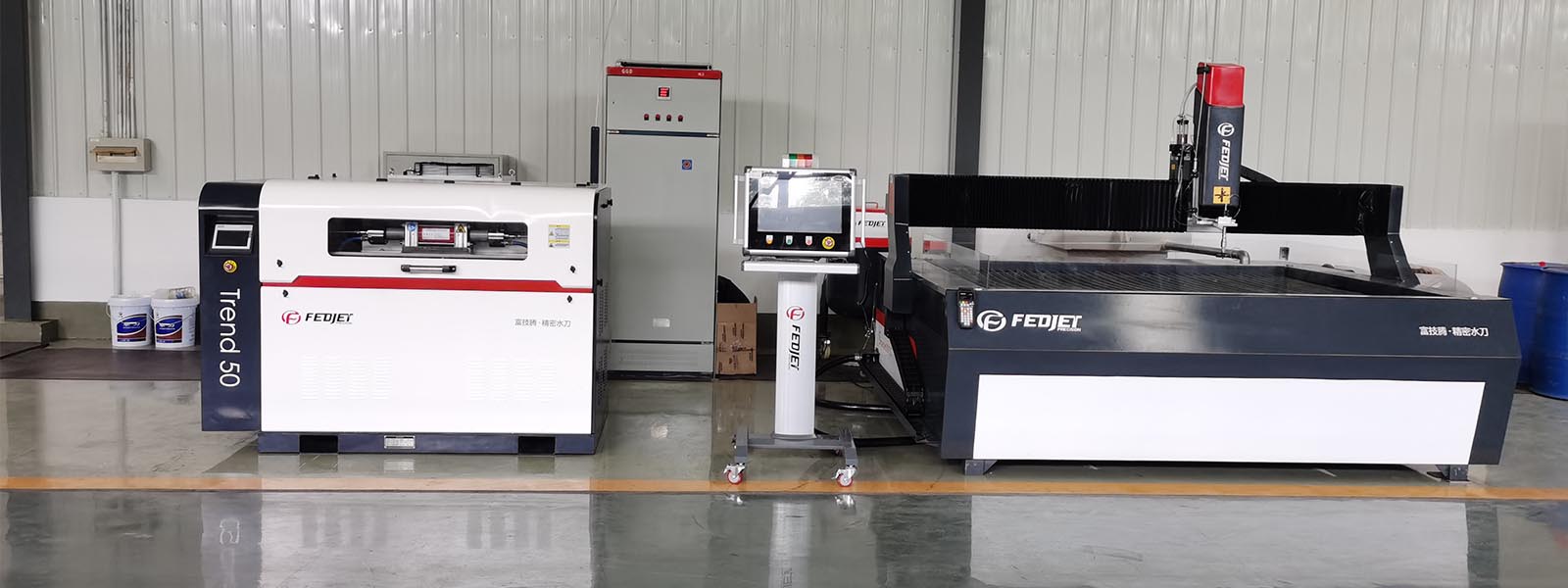
Where gantry machines optimize for large work envelopes, compact gantry systems like Fedjet's SmartJet G Series prioritize floor space efficiency and precision. The integrated bridge structure reduces the machine's footprint while maintaining the rigidity advantages of gantry geometry.
The SmartJet G delivers comparable precision metrics to its larger sibling—0.1mm cutting accuracy, ±0.03mm repeatability, ±0.035mm linear accuracy—in a smaller package. Table sizes range from 800×800mm to 3000×1000mm, making this series suitable for precision prototyping shops, electronics manufacturers, and small-to-medium fabricators. Maximum rapid traverse is 8,000 mm/min, lower than the PowerJet G, but this reflects the precision-focused rather than throughput-focused design intent. The PC i-Telli control system with mobile console enables ergonomic operation in tight shop floor layouts.
Cantilever waterjet cutters position the gantry on one side of the worktable, with an open structure on three sides. This configuration sacrifices some rigidity compared to gantry designs but provides significantly easier material loading and unloading—a meaningful ergonomic advantage in high-mix, low-volume production environments.
Fedjet's SmartJet C Series targets this use case. The one-piece cast machine bed provides inherent stiffness while the open three-side access enables efficient part handling. X-axis travel options span 2.5m to 12m, with Y-axis options of 1.5m or 2.0m. The dual-station cutting option allows one station to be loaded while cutting proceeds at the other, directly improving effective throughput. Maximum rapid traverse reaches 10,000 mm/min with repeatability of ±0.025mm, marginally tighter than the gantry variants. Working pressure of 360 MPa (approximately 52,000 PSI) positions this series for continuous production use rather than ultra-high-pressure specialty applications.
For applications demanding sub-0.05mm cutting accuracy—medical device manufacturing, aerospace instrumentation, advanced ceramics—full-enclosure precision machines represent a distinct category. These systems sacrifice work envelope size for thermal stability, vibration isolation, and positional precision that standard industrial configurations cannot achieve.
The PrecisionJet Series from Fedjet operates in this segment. With cutting accuracy of 0.05mm and repeatability of ±0.01mm, this machine targets applications where waterjet's cold-cut advantage intersects with micron-level tolerances. Work areas are necessarily compact—X, Y, and Z axes each offer 0.6m, 0.8m, or 1.0m travel options—but the full-enclosure design maintains consistent environmental conditions throughout the cutting process. Rapid traverse at 10,000 mm/min is deliberately moderate; the engineering priority is precision, not speed.
A waterjet cutting machine for sale listing typically presents headline specifications as a package. What separates technically rigorous procurement from specification-matching is understanding how each subsystem contributes to overall performance—and recognizing which components a manufacturer engineers in-house versus sources from third-party suppliers.
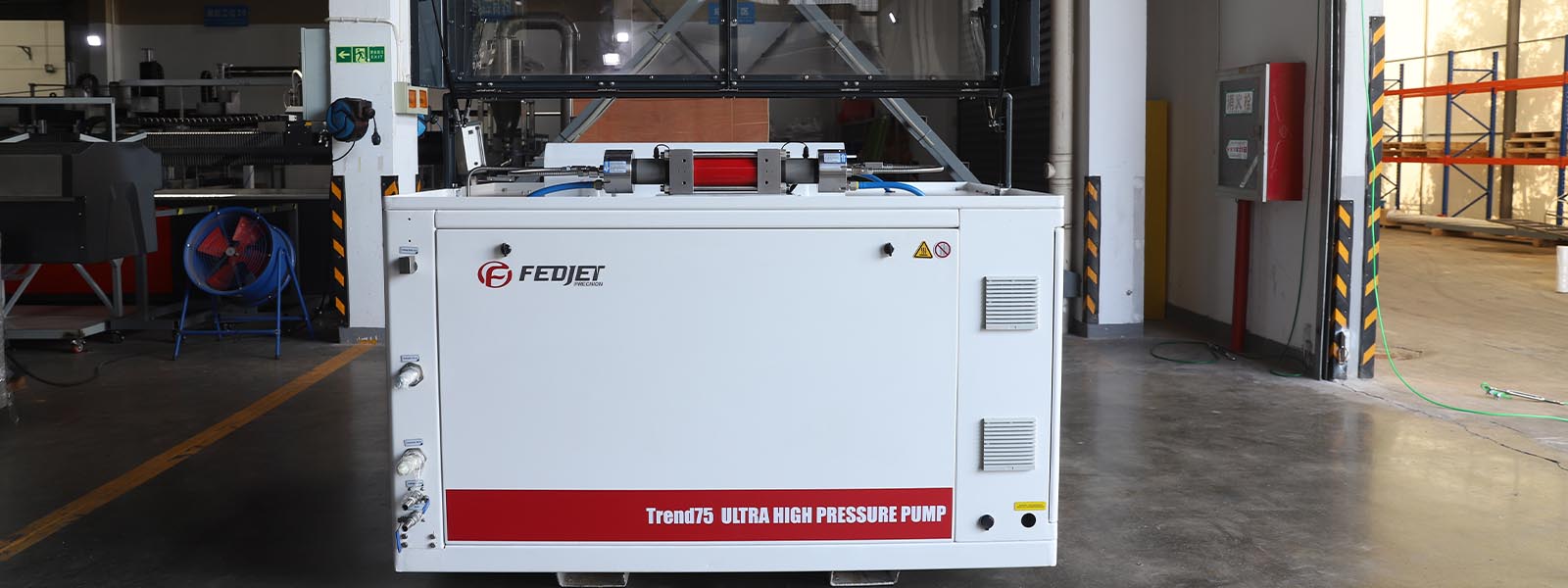
The pump is the heart of any waterjet system. It generates the pressure that accelerates water to velocities approaching 900 m/s (roughly Mach 2.7 at the nozzle exit), transforming hydraulic energy into kinetic cutting energy. Pump architecture, pressure stability, and maintenance requirements directly determine both cutting performance and operating cost.
The waterjet industry operates two primary pump architectures: intensifier pumps and direct drive pumps. Intensifier pumps use a hydraulic cylinder to amplify water pressure through a piston/intensifier assembly, generating pressures from 60,000 to 100,000+ PSI. Direct drive pumps directly couple an electric motor to a high-pressure plunger pump, typically limiting maximum pressure to 55,000 PSI. For production-grade metal cutting, intensifier architecture is the industry standard.
Fedjet's Trend Series UHP intensifier pumps represent the manufacturer's core engineering distinction. Rather than assembling pumps from purchased components, Fedjet engineers and manufactures the pump assembly in-house—a claim verifiable through their National High-Tech Enterprise certification and ISO 9001:2015 registration. The Trend Series delivers a maximum working pressure of 60,000 PSI (413 MPa) with an optional upgrade to 90,000 PSI for specialty applications. Continuous working pressure is rated at 360 MPa. Flow rates span 1.14 to 6.8 LPM depending on configuration, with motor power options ranging from 11KW to 90KW.
Key engineering features in the Trend Series include AIPT technology (Advanced Intensifier Performance Technology), which Fedjet states improves hydraulic efficiency and extends seal life—a meaningful specification since intensifier seals represent one of the highest-frequency consumable replacement items. The ESL (Enhanced Seal Life) intensifier assembly, variable displacement oil pump, touchscreen HMI interface, and dual-pressure operational mode give operators flexibility to match pressure settings to material requirements, reducing consumable wear during non-cutting transitions.
Physical dimensions of 1530×1230×1070mm and compatibility with 220V/380V/415VAC 50/60Hz power supplies simplify installation logistics for international buyers. Nozzle diameter options from 0.1 to 0.5mm cover the range from ultra-fine precision cuts to aggressive stock removal.
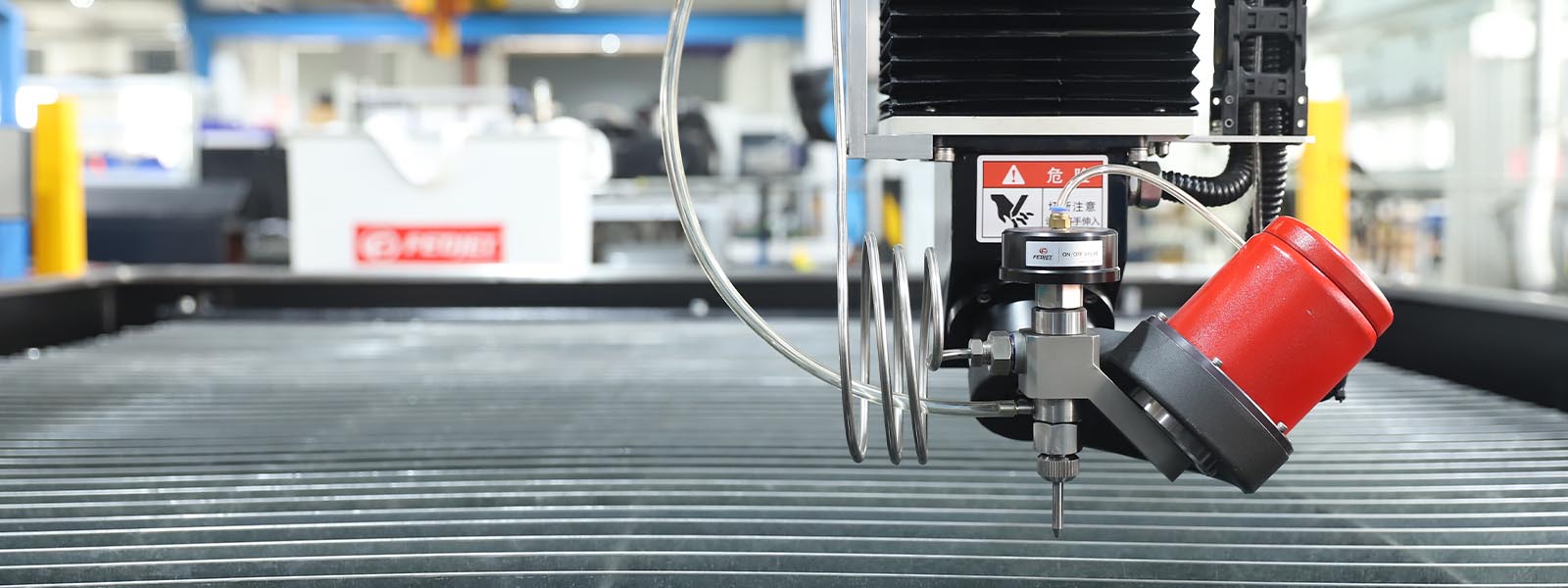
The cutting head receives high-pressure water, mixes in abrasive media (for abrasive cutting), and focuses the resulting water-abrasive stream through a precision nozzle. Head design governs mixing efficiency, jet coherence, and—critically for 5-axis systems—the ability to maintain jet perpendicularity during angular cutting.
Fedjet offers two 5-axis cutting head options alongside their standard 3-axis system:
The 5A-Taper10 (±10° Dynamic 5-Axis Cutting Head) adds A-axis and B-axis rotation (±10° each) to the standard XYZ traverse. With external dimensions of 320×290×314mm and a weight of 10.5kg, it integrates with Fedjet's i-Telli intelligent control system. The core function is automatic compensation of jet lag—the distance between abrasive entry and full jet coherence—and automatic taper correction, reducing bevel angle to below 0.5° on non-perpendicular cuts. Applications span stone countertop edge profiling and mitre joints, structural steel and thick-plate beveling, aerospace composite machining, art glass shaping, and ceramic tile cutting.
The 5A-Rotary60 adds C-axis infinite rotation around the Z-axis to the standard tilting capability, with A-axis deflection of ±90°. This configuration fully integrates 3D functionality with precision waterjet cutting, enabling both planar bevels and true rotary surface machining. The practical advantage is eliminating the mechanical repositioning steps required on fixed-head systems, reducing cycle time on complex multi-angle parts.
Both 5-axis heads are purpose-engineered for their respective machine series and controlled through Fedjet's unified i-Telli platform, ensuring that taper compensation algorithms, angle calibration, and motion planning operate as an integrated system rather than a bolt-on addition.
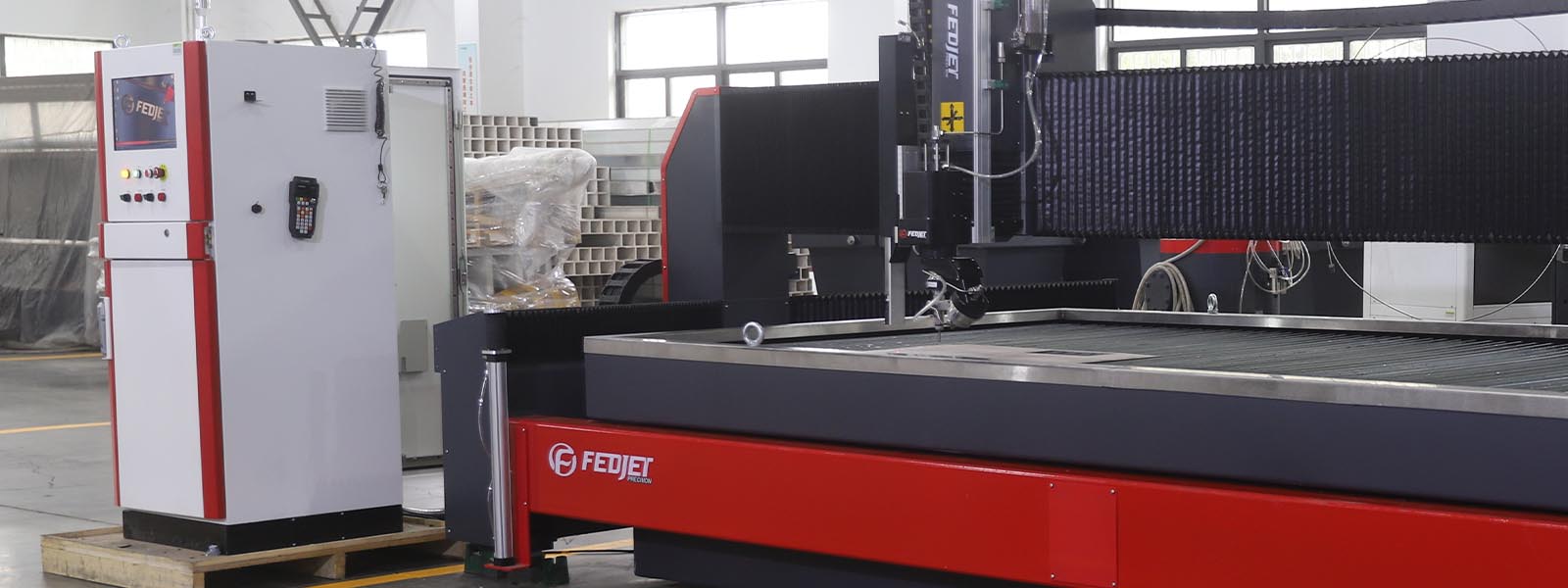
The control system translates CAD geometry into physical motion trajectories. For waterjet applications, this requires precise velocity control (cutting speed directly affects edge quality), pressure modulation during pierce and traverse transitions, and integration with optional accessories like abrasive flow regulators and vision systems.
Fedjet's i-Telli PC-Based Bus Control system provides this integration layer across all machine series. The PC-based architecture enables CAD/CAM compatibility with standard file formats including DWG, DXF, STEP, and IGES, allowing direct import from engineering design software without proprietary translation steps. The touchscreen interface lowers the operator learning curve while the bus-based communication architecture reduces wiring complexity compared to traditional PLC-based systems.
The axis count decision is among the most consequential specification choices in purchasing a waterjet cutting machine for sale. It directly affects machine cost, programming complexity, and the range of parts you can produce without secondary operations.
3-axis waterjet cutting machines move the cutting head in X, Y, and Z linear directions only. This covers the vast majority of 2D profile cutting requirements—flat sheet or plate materials where the cut geometry lies in a single plane. For job shops cutting metal plates, stone slabs, or composite sheets with square-edge profiles, a 3-axis configuration provides full capability at the lowest cost point. Fedjet's 3-axis standard configuration includes both the ACS (Abrasive Cutting System) for mixed-material cutting and the OWCS (Optimized Water Cutting System) for pure water applications.
5-axis waterjet cutting machines add two rotational degrees of freedom—typically A-axis (tilting around X) and B-axis (tilting around Y), or C-axis (rotation around Z). This enables the cutting head to maintain jet perpendicularity to the actual workpiece surface even when cutting angled faces, beveled edges, or compound-angle contours. The practical output is a taper angle below 0.5° on cuts that would exhibit 1–3° taper on a 3-axis machine, and the elimination of secondary machining for parts requiring angled surfaces.
The decision framework is straightforward: if your parts require square edges on non-perpendicular faces, 3D surface machining, or mitre/compound-angle cuts, the 5-axis premium is justified. If your production is dominated by flat-stock 2D profiling, a 3-axis configuration delivers the same cutting performance at a lower capital cost with simpler programming.
Waterjet cutting operates in two modes, and a given machine must be configured appropriately for its intended material range.
Pure water cutting uses only high-pressure water, without abrasive media. The water stream alone—with exit velocities approaching 900 m/s—effectively cuts soft, fibrous, or food-grade materials where contamination from abrasive media is unacceptable. Target materials include rubber, foam, textiles, gaskets, carpet, leather, food products, and thermal insulation boards. Pure water cutting produces no heat-affected zone and no toxic fumes, making it suitable for food processing equipment and medical manufacturing.
Abrasive waterjet cutting injects a hard abrasive media (typically garnet, with grain sizes from 80 to 220 mesh) into the mixing tube. The abrasive accelerates within the high-velocity water stream, providing the material-removal mechanism that enables cutting of metals, stone, glass, and composites. Abrasive cutting requires the ACS system and consumes approximately 0.3 to 0.8 kg of abrasive per minute depending on material hardness and thickness.
Fedjet's SmartJet C Series supports both modes on the same platform, enabling shops that process mixed material ranges—rubber gaskets alongside steel brackets, for example—to use a single machine for both applications. The WSS water softening system extends the operational life of high-pressure seals and intensifier components by removing calcium, magnesium, and dissolved organics through low-pressure nanofiltration deionization.
When reviewing a waterjet cutting machine for sale listing, these parameters represent the most technically meaningful benchmarks:
Maximum working pressure should be 60,000 PSI (413 MPa) or higher for metal cutting applications. Pressures below this threshold noticeably reduce cutting speed and limit maximum material thickness in harder alloys.
Cutting accuracy and repeatability describe positional precision. Fedjet's specification system illustrates the range: mid-tier machines like the SmartJet G and C series specify 0.1mm cutting accuracy and ±0.03mm repeatability, while the precision-class PrecisionJet achieves 0.05mm accuracy and ±0.01mm repeatability. For production runs with tolerances tighter than ±0.1mm, the precision-grade specification is necessary.
Maximum rapid traverse speed affects non-cutting repositioning time. The PowerJet G leads at 20,000–30,000 mm/min, while the precision-class PrecisionJet operates at 10,000 mm/min. Higher traverse speeds improve effective throughput on complex multi-part nests.
Work envelope dimensions (X, Y, Z axis travels) must accommodate your largest production part with adequate margin for fixturing and edge clamping. Fedjet's range—from the PrecisionJet's compact 0.6–1.0m cubes to the PowerJet G's 20m Y-axis customization—covers prototypes through large-format industrial panels.
Control system architecture matters for integration. Fedjet's i-Telli PC-Based Bus Control with DWG/DXF/STEP/IGES compatibility represents a modern approach that eliminates proprietary file translation, but buyers should verify that their existing CAD/CAM workflow is supported before purchase.
The waterjet cutting machine price quoted in a sales listing represents typically 20–30% of total cost over a 10-year operating period. A rigorous procurement analysis incorporates:
Abrasive waterjet cutting machine for sale listings should be evaluated on intensifier architecture, not just maximum pressure. The intensifier pump design separates production-grade equipment from entry-level imports. For production facilities running multi-shift operations, the abrasive regulator's flow control precision directly impacts material consumption rates and cut quality consistency across extended runs.
Intensifier seal replacement occurs every 500–2,000 operating hours depending on pressure levels and water quality. Each seal kit costs $200–800 with 2–4 hours of labor. Fedjet's WSS water softening system extends seal life by removing scaling minerals from the intensifier water supply. High-pressure tubing and fittings require periodic replacement per OSHA and EU Pressure Equipment Directive (PED 2014/68/EU) requirements—inspection scheduling should be factored into planned maintenance intervals.
Jiangsu Fedjetting Tech Co., Ltd. (Fedjet) has manufactured waterjet equipment since 2012, holding National High-Tech Enterprise certification and exporting to 135+ countries with over 3,000 brand customers. This export volume across 15+ years demonstrates sustained quality and international support capability. The engineering differentiator is vertical integration: Fedjet manufactures its own UHP intensifier pumps rather than sourcing and assembling third-party components. This distinction—verifiable through ISO 9001:2015, ISO 45001, ISO 14001:2015, plus CE and SGS product certifications—means pump performance, control system tuning, and warranty support all originate from a single engineering organization.
The product range spans four machine architectures:
The PowerJet G Series (gantry-style, 3/5-axis) handles large-format production with X-axis travels up to 5.0m and Y-axis to 20m, 30,000 mm/min fast jog speed, and 60,000 PSI cutting pressure. The fully enclosed "Clean & Quiet" design reduces airborne abrasive in production environments.
The SmartJet G Series (compact gantry, 3/5-axis) delivers 0.1mm cutting accuracy and ±0.03mm repeatability in a smaller footprint with table sizes from 800×800mm to 3000×1000mm, suited to precision prototyping and small-to-medium fabrication.
The SmartJet C Series (cantilever, 3/5-axis) features three-side open access and dual-station capability for simultaneous loading and cutting, with ±0.025mm repeatability.
The PrecisionJet Series (ultra-precision enclosed) achieves 0.05mm cutting accuracy and ±0.01mm repeatability in a full-enclosure design, targeting medical, aerospace, and advanced ceramics applications.
These four lines share purpose-engineered accessories: the 5A-Taper10 (±10° dynamic, <0.5° taper) and 5A-Rotary60 (infinite C-axis rotation) 5-axis cutting heads, the Trend Series UHP intensifier pumps with AIPT technology and 11–90KW motor options, the precision abrasive regulator with 20-step flow control, the WSS water softening system, and the vision camera recognition system that generates cutting paths from photographed material layouts.
Customer validation includes factory acceptance in Australia, throughput confirmation from U.S. customer Hans, stability endorsements from Thai buyer Marie, innovation recognition from Saudi customer Ali, and multi-machine evaluations across Poland, France, and the Netherlands. Fedjet backs purchases with 24-hour response time and free 7-day on-site installation.
Selecting a waterjet cutting machine for sale requires aligning five primary variables: your material range (soft/fibrous vs. metals/composites), your precision requirements (standard industrial vs. ultra-precision), your work envelope needs (compact prototyping vs. large-format production), your axis configuration requirements (2D profiling vs. 3D beveling), and your operating cost sensitivity (consumable efficiency, maintenance intervals, energy consumption).
For most industrial buyers, the SmartJet G or SmartJet C Series represents the optimal balance of precision, work envelope, and operational flexibility. For large-format production environments—stone fabrication yards, aerospace panel processing, automotive stamping-die manufacturing—the PowerJet G Series provides the necessary work envelope and traverse speed. For precision manufacturing with micron-level tolerances, the PrecisionJet Series is the appropriate specification.
Regardless of which machine series matches your requirements, verify that the manufacturer holds verifiable certifications (ISO 9001:2015, CE, SGS), manufactures its own pump subsystem, and provides support infrastructure appropriate to your geographic location. The waterjet cutting machine market rewards technically rigorous procurement—the difference between a well-specified purchase and a specification-matched one often determines whether a machine delivers its promised ROI over a 10-year operating horizon.
Request a detailed quotation from Fedjet's technical sales team, specifying your material range, maximum part dimensions, tolerance requirements, and intended operating hours per shift.


 Cantilever-Style Waterjet Cutting Machines


